Swiss glaciers lose 5.5% of their ice in their second-worst year
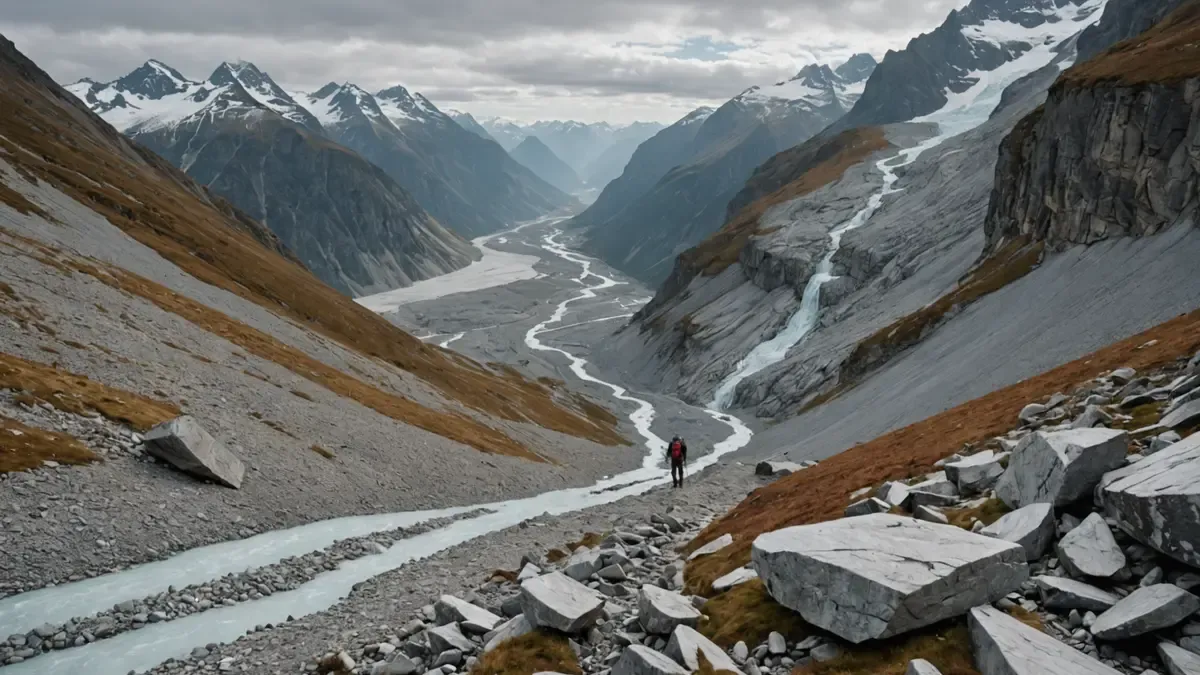
Swiss glaciers lost 5.5% of their remaining volume in 2026, the second-heaviest loss since measurements began, behind only the record year of 2022. The figures come from the Swiss glacier monitoring network, GLAMOS, whose annual report was published on 23 September, and from the Swiss Academy of Sciences (SCNAT), which presented them on 1 October as another “catastrophic year” for the ice.
The 2026 figures
GLAMOS measured 23 glaciers in September and extrapolated the results to the roughly 1,300 in the national inventory. The GLAMOS annual report gives an average mass balance of −2.86 metres of water equivalent for 2025/2026, just short of the −3.13 recorded in 2022 and far beyond 2023, when the volume fell by 4.4% (against 5.9% in 2022). In absolute terms, Switzerland lost about 2.5 cubic kilometres of ice and had some 42.6 km³ left at the end of the summer, over 30 km³ less than in 2000. Glacier area is now estimated at 714 km², a third less than in 2000.
Volume has fallen by almost 20% since 2021, and by 27% over the decade 2016–2026, against 10% in the 1990s. For four large glaciers, Allalin, Clariden, the Great Aletsch and the Rhône, 2026 was the worst year on record, worse even than 2022. SCNAT, drawing on GLAMOS and its Commission for Cryosphere Observation, reports that the Bella Tola glacier in Valais and the Plattalva glacier in Glarus have disappeared, and that the Rhône glacier melted right up to its highest measuring points. The glaciologist Matthias Huss told Swissinfo that this summer may have marked the end of at least 30 more small glaciers.
Several of the hardest-hit glaciers lie in French-speaking Valais or on its edge. Tsanfleuron, in the Diablerets massif, posted the most negative balance of all the monitored glaciers, at −3.9 metres of water equivalent; Plaine Morte, above Crans-Montana, and Otemma, in the Val de Bagnes, also went beyond −3 metres. Even at their highest measuring points, glaciers such as Giétro, Otemma and Tsanfleuron lost 2.5 to 4 metres of ice, in areas where several metres of winter snow should normally survive the summer.
Why this summer was so hard on the ice
The winter of 2025/2026 was one of the ten least snowy on record, mainly because it was dry. Then every month from May to September brought at least one heatwave, and the freezing level stayed above 4,000 metres for 76 days, more than twice the average and a record, RTS reported. By September there was no snow left even at 3,500 metres. “In such conditions, Alpine glaciers have no chance of survival in the long term,” the academy concluded. Slightly more snow than in 2022, and less Saharan dust darkening the surface, are what spared 2026 a new record.
In French: « fonte des glaciers » — glacier melt. Swiss reports measure it through the « bilan de masse », the mass balance: snow gained in winter minus snow and ice lost in summer, expressed in metres of water.
What it means if you live in Romandie or come to the mountains
Nearly 138,000 French citizens were on the consular register in the district run from Geneva on 1 January 2026, according to the French government order that sets the number of consular councillors, the same register used to vote from abroad in 2027. For them, as for weekend visitors, the consequences are practical.
Water. Between July and September, Swiss glaciers released about 2,200 billion litres of water, more than four times the annual drinking-water use of all Swiss households, SCNAT says. That meltwater still softens summer shortages, but GLAMOS considers that peak meltwater has probably passed: with less ice left, less water will reach the valleys, raising “important challenges” for irrigation, hydropower, ecology and transport, especially in droughts.
Hydropower. Glacier retreat has added around 1.4 TWh a year to Swiss hydropower since 1980, about 4% of output, and some 9% of the electricity of Valais power plants, according to a 2018 study led from the University of Lausanne and reported by RJB; that share is expected to shrink. SCNAT notes that at the Findel glacier, near Zermatt, meltwater is captured for electricity, while the ice that stood beside the intake forty years ago has almost gone.
Paths and huts. The Swiss Alpine Club (CAS) has 152 huts, and 65 stand in permafrost zones that could become unstable, RTS reported in October; adapting them costs the club CHF 6 to 7 million a year. The Konkordia hut above the Aletsch glacier now stands some 300 metres above the ice, against 50 metres originally, and its staircase of more than 500 steps has to be extended every two or three years. In Valais, Damien Revaz, president of the CAS Monte Rosa section, told Rhône FM that the route from the Vignettes hut to the Évêque was “more demanding” this summer, and the hut’s guardian said the nearby Pièce glacier had lost six metres of thickness. The club’s own study expects the number of huts reached across a glacier to fall from 22 to 6 within 25 years, the CAS says. Ask the hut about the approach before setting off.
Belgian visitors who drive down will soon have a second vignette to think about, since Belgium is preparing a road vignette of its own from May 2027. And for French readers who own a chalet on the French side of the Alps, the next deadline is fiscal: the council tax on second homes is due on 15 December.
The next dates to watch
- Winter 2026/2027: snowfall sets the starting point for next year. GLAMOS uses 30 April as the reference date for the end of winter, when snow depth on the glaciers is compared with the norm.
- Summer 2027: the guarded huts reopen for the season; check each hut’s access conditions before booking.
- September 2027: end-of-summer measurements on the monitored glaciers; this year’s report came out on 23 September.
This article was written with the assistance of artificial intelligence.
Editorial policy and use of artificial intelligence